
13. A Year Without Headphones
The unexpected quest to listen less, Listings for indoors and outdoors, Plovdiv, and King Stingray ❤️🔥



Through The Trees (2024)* feels like a fitting song to kick off the first 8MM of the new year. In their own words, King Stingray are “from a small place but we’re singing about big things”. This outlook, with references to country and community connection, is joyfully upfront in the sentiment of the song's video and galvanising hook, “Let's not waste any more time.”
And, please don’t waste time: 1. Letting this song wash over you; and, 2. Listening to the entirety of their For The Dreams LP. You need it in your life! It’s front-to-back Yolŋu surf rock get-up-and-dance bangers. With lyrics in Yolŋu Matha (Northeast Arnhem Land, Northern Territory) and English, every song feels like a heartfelt jam session with mates. For me, it’s the rich sonic palette of yiḏaki, bilma, stellar drumming, and guitars that demand the volume stay cranked. I promise that you’ll be smiling and savouring every single second of the album.
🎶 More about King Stingray in this issue’s Postcard from Plovdiv further down.
If I had to describe the past 12 months — starting in September 2024 — it would be as a year with no headphones.
Or, without the clickbait headline, a year with less headphones.
The backstory:
For almost 15 years, I’ve woken up and started listening to something.
Since joining the smartphone economy with an iPhone in March 2011, I’ve spent much of my waking hours with some sort of auditory input.
When I worked in management, social media, and digital marketing between 2013 and 2021, my podcast consumption was nearly constant. This shot way up with my first Bluetooth headphones and a roughly hour-long commute in 2019. If I wasn’t interacting with someone, I was working my way through a queue of saved business episodes and new drops from my subscriptions. Throw YouTube in the mix over the last few years, and, as I type this, it’s been reservoir gates that I’ve kept open on myself for a decade-and-a-half.
For all these years, I’ve had something in my ears to stay up-to-date, informed, educated, or entertained. If there wasn’t anything I wanted to listen to, I’d hunt for ages until I found something to listen to. If that turned up nothing, I’d replay something I’d already enjoyed.
There was a lot of joy during this time. I learned a lot. Podcasts reliably eased my loneliness. Hosts were social connections, plus the stories were funny, thought-provoking, or inspiring. They helped me stay afloat in the amorphous years of solo drives back and forth for work, followed by remote living and working overseas throughout the pandemic lockdowns, and then building a freelance business from 2022 to 2024.

The critical juncture: from bad to worse
I’ve already demarcated that 2024 was a personal shift in what I put in my ears.
I was fried and felt like I had no time — all the time.
At the start of 2024, my husband and I had just moved to a new country and had a home base for the first time in two years. Putting down roots in one place and transitioning to a smaller city meant countless adjustments that took it out of me.
As part of our move, I was also working to prioritise my creativity. I had serious creative goals for the first time since I was 17 — 17 years before.
These were major changes that required a lot of energy. It demanded even more because I felt like I had a permanent hole in my brain. I’d felt this way for years.
Amid the stress and trying to adapt to our new home, if I wasn’t scrolling and I wasn’t working, I’d be streaming something, anything I could get my hands on. Often, I wouldn’t listen to it, I’d just let it hum in the background. To hang in there, I kept soothing my overwhelm and mental busyness by listening, listening, listening. I did more of it than I ever had before.
My ears were always connected. My mind was, too.
Plugging or putting my headphones was — and still is — a weighted blanket for my brain. It muffled the world around me. I’d feel like I could disassociate while locking in. But the feeling it gave my brain was like a cloth boarding over a broken window: I’d feel the wind whistling through the hole, the fabric would swell and billow, but it would hold, barely, and I could continue, chilled but comforted and semi-intact. My brain was half-held with this makeshift covering and half-frozen from the hole.
I’d be lying if I said that I wasn’t continually frustrated with myself.
The road map to the turning point:
For a little while, I opted to supplement in any way to achieve that coveted “digital hygiene”*.
I’d also have these conversations with pals about how we’re all online all the time. Even so, it didn’t seem to be a problem for others in the way it was for me. Or maybe it was just working across time zones, and the general feeling of turbulence that meant whatever I was consuming took the edge off how hard I was finding things.
As work and life admin ramped up in the three months from February to April 2024, I kept thinking about how I could turn things around. I’d fret about what I could do while scrolling in bed or trying to brush my teeth without listening to something.
Around this same time (I can’t quite remember exactly when), I came across this advice: Create Before You Consume. A straightforward premise for all prioritisation — in essence: air gapping* my attention.
I’d repeat the words to myself, asking,
But what if you did, “Create before you consume”?
Then, What exactly constituted consuming?
And then, What part of it was a phone/internet addiction and what part was just the hole in my brain?
For the next six months, that advice from Spring 2024 gnawed at me. Deep down, an unshakable knowing ground at my frazzled brain. This, on top of the bloated sensation of whatever I’d consumed, macerated with the sick feeling of wishing I’d created instead of consuming. I didn’t know how to stop.
The turning point: Going cold turkey on my headphones
By August 2024, my brain didn’t have just one hole; it was mush.
At a rock bottom that I’d fought for over 18 months, I made a final desperate start on The Artist’s Way. Barely treading water, with the book freely available, I decided it was now or never. As it turned out, the course was like burning the house down and putting it out with espresso cups of that water.
I’d resisted Julia Cameron’s seminal course since a neighbour gave me the book in January 2012. It had felt too serious. Like something that wasn’t meant for me. Turning to the book now was a Hail Mary. I’d repurchased the book, deep in our third lockdown in mid-2021. I’d put it straight on the shelf and never opened it.
The immediate requirement to change a lot of what I was doing hinged on time management. It was nearly impossible to keep up with the course without reducing leisure screen time. The only way I found to absorb each week’s essays was rereading and note-taking. The tension with my attention and how it challenged what I did in my waking hours was inescapable.
The tagline of The Artist’s Way is, “Discovering and recovering your creative self”. Wrestling with the more spiritual* aspects of the recovery led to more upheaval. The daily Morning Pages brought up the long-term self-consciousness and loathing I had of free writing. Excavating memories deliberately left unvisited over the course of high school and university was a spotlight on all the artistic endeavours I’d abandoned.
Getting to Week 4 and facing the prospect of the weeklong reading deprivation was hell. It very nearly made me quit the book. But the program wasn’t the cure for my headphones. It was the cause for rewiring my relationship with them.
As Cameron writes in her overview of the week:
“Reading deprivation is a very powerful tool—and a very frightening one…We gobble the words of others rather than digest our own thoughts and feelings, rather than cook up something of our own.” — Julia Cameron
I couldn’t entertain a week without reading any books for a second*. For a long time, it’s been both an immovable spiritual and mental health practice for me.
It was pretty obvious that there were many other things I could deprive myself of, so I chose this freestyled cold turkey abstinence of:
All internet reading — Substack, editorial sites and mastheads, and blogs
All broadcast and information media — YouTube, podcasts, and news
All artistic media — Music, television, and movies (including streaming)
This turned out to be a life-changing move.
The aftermath of headphone deprivation
After seven days, I noticed that everything felt quieter and calmer.
In this new stillness, it was unequivocally clear that constant consumption had a numbing effect on my entire brain.
Critically, almost all of the time while wearing headphones, I felt distracted and mentally fractured.
I was struggling to pay attention — let alone focus on — whatever was happening in my life, or my work, or my creativity in the moment I was in.
A headphone reckoning
By turning off everything, other things became louder and louder.
The starkest revelation was tied to my habit of listening to something while doing other things.
How disconnected and detached from the moment I felt because of constant auditory interference — namely, the podcasts and YouTube essays — to the point that it was destructive.
That listening to podcasts, and sometimes music, was like trying to pay attention to someone speaking while watching or listening to something else.
That I found it nearly impossible to walk my dog with headphones in (spoiler: we’d just started getting to know him when I did this and I found/still find that my mind wanders, and I lose track of what he’s doing).
The strangest part of the headphone fast was what my less-addled brain did, and the fact that this proved as important as the wake-up calls above.
By cultivating silence, I observed and recognised that I’d unwittingly turned up the volume on my own creative voice. Taking a week off from consuming through headphones showed me that I was drowning out a lot.
And, consumption was actually blocking me from:
Hearing my own ideas.
Tuning in to the present moment as a tool for creative fuel.
Catching and staying on the train of writing to capture unspooling thoughts.
What direction next: My quest to listen less
In the past, I’d heard people say that there was so much going on that they couldn’t hear the sound of their own thoughts.
It turns out that my internal voice is its own kind of GPS system, saying, “You are here” to situate, then guide. Being drip-fed soundbites of my own ideas scratched out a map for alternative pathways of doing things.
Now, I could discern my own — albeit vague — trajectory because I felt present right where I was, senses unmuffled.
And the loudest wake-up call of all: Where do you go when you can go in the direction you truly want?
A Year Later: The Winding Road of Headphone Use
Realising there was a way for me not to constantly, mindlessly go about things was a shock.
I wanted to maintain an oriented mode of existence. One where I wasn’t like a compass I’d magnetically interfered with. But this is tricky when I love listening to things.
So this is how I’ve worked to be the navigator of my life and creativity — not my phone, headphones, or the siren call of the internet.
The headphone direction I chose to follow for the next 12 months, from late 2024 throughout 2025 was this:
From: Shoving them in my ears and looking for something to listen to
➡️ To: Consciously choosing headphone use based on whether I’d done anything creative and whatever tasks I needed to focus on nextFrom: Always listening to something when out and about
➡️ To: Not wearing headphones while dog walking and only listening to podcasts indoorsFrom: Arbitrary use at any time of day
➡️ To: Restricting headphone use to at least one hour either side of waking and sleepingFrom: In-ear listening as a default for “focus“ or to minimise noise in our apartment
➡️ To: Using a speaker for broadcast and music at home
2026 and Beyond
After a year spent experimenting with headphones and my online consumption, the key takeaway is that my attention span is something I continue to be at odds with. Before the digital infinite, I definitely had school reports that flagged my need to concentrate and pay attention, but I could do it.
As January begins, I’m still consuming more than I’d like before creating anything.
The core truth remains the same: my attention is always affected, irrespective of whether I’m listening, scrolling, or zoning out online. It’s a correlation in the quality of my focus, how considered I feel in my being and doing, and how distractible I am with headphones in, even with nothing playing, versus when I don’t have them in.
In terms of writing and preserving a whole brain, I can’t ignore the similarity between being slightly distracted and having my attention split. In recent times of enhanced workflow, creativity, and mindfulness, the common theme is always intentional consumption.
Over the last few months, the questions I’ve started asking myself before I choose to do this are:
Am I trying to distract myself from what I need to do?
Am I seeking some kind of dopamine novelty via the temporary attention splitting or bifurcation-of-attention distraction?
Am I seeking a fleeting escape that feels permissible?
Am I avoiding putting all my mental faculties into something that’s difficult to focus on because I find it hard to dedicate my attention like this or because the task is hard?
So, with every input — headphones, phone and computer — the same goal remains: to consume selectively more often than I’m consuming the entire internet.
Dropping into a state of no noise, no disruptions, and nothing to disturb the quiet is a path to stillness and locking in. The pockets of focus are still new after years of being online all day, every day. That it’s hard-won feels precious, then that reinforces that I don’t know an adult life without the internet and uncapped swathes of passive stimulus.
And lastly, more and more frequently, purposeful silence is golden, too.
There is still so much to write about this topic, including: How not consuming affected my relationship to noise, feeling more overstimulated in busy settings like airports, what the pursuit of silence feels like, headphone level warnings from phones, and the question of risk and net neutrality re: technology consumption compared to previous generations. Let me know if you’re interested! 💌

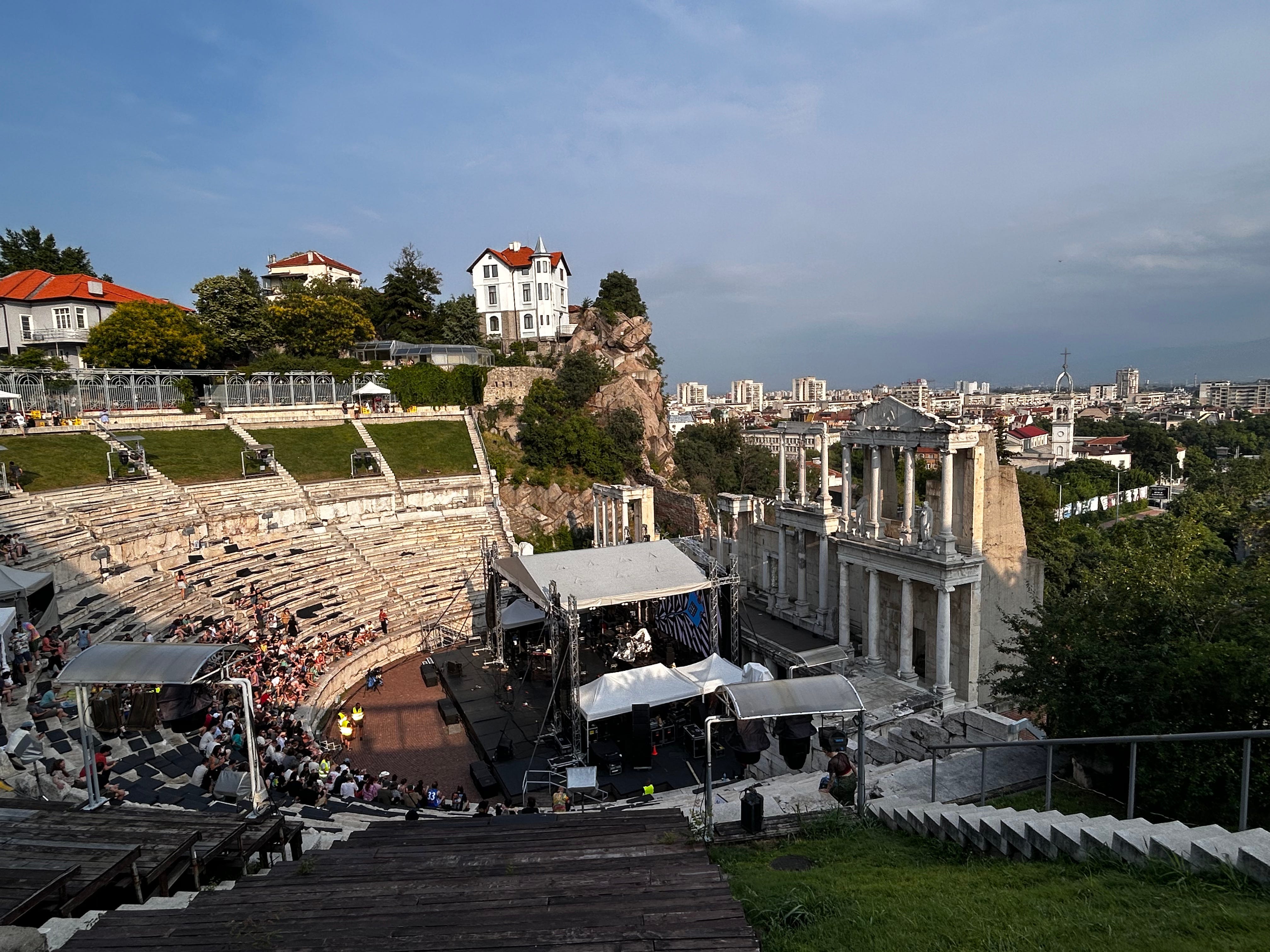
This post comes to you from the seven hills of Plovdiv, in southern Bulgaria. It’s a small city, Bulgaria’s second-largest, charming and real. Its history feels worn openly, and these layers of the past are accessible whichever way you wander. It’s also a gateway to much of Bulgaria’s spectacular nature and culture. You can fly here, though most visitors make their way overland via train or bus. We arrived by train from Sofia, the capital, and departed on the international bus bound for Türkiye.
So often when I’m in a place I want to message everyone I love and say, I miss you and I wish you were here, declaring, “You’d love this.” In this case, I really do think you would love Plovdiv as much as we did.
If this were physical mail, it’s safe to say that I had too much fun and lost track of the time needed to write and send postcards. Looking back now, it feels right to blame it on two seemingly disparate things that feel related. The first thing is that Plovdiv is described as “Ancient and eternal”; and the second thing is the term “Collective effervescence”. There was a feeling of kismet the whole three days we stayed there; pinching ourselves that we’re alive and able to experience two ancient and sacred things in real time. The collective beat of heartbeats, in the thousands, in rhythm reaching across space and time. The city’s pulse seemed to have synced to the passion of all the Bulgarian and international fans there, like us, for the King Gizzard and the Lizard Wizard Europe Residency Tour. The chance for togetherness and shared experience conjures that portal between memories that defy ageing.
We’d travelled to Bulgaria to see KGLW, but what still makes me tearful is seeing King Stingray. Their entrance with the yadaki (Yolŋu didgeridoo) echoing through the marble arena setting as the sun dipped behind Plovdiv’s mountains. I read that with Collective effervescence, “There’s an electric, bigger-than-yourself feeling that comes when emotions sync up in a group and ordinary moments start to feel extraordinary.” Hearing First Nations art in the ancient Roman theatre of Philippopolis with music lovers from almost everywhere was that. Then, knowing we were seeing two Australian acts on a sold-out string of European shows made our group even more emotional. Maybe that transcendence happened everywhere over the summer of 2025, over the course of those shows, but it was Plovdiv that I dream of still. The warmest welcome from Bulgarians and how art can unify us, regardless of who we are, and where we’re from.
😍 You can also stream the video recording of the show we went to — and a lifetime bonus hat tip to King Gizz for recording and making every show available to every fan. Bloody legends!

What are the Listings?
Listings have traditionally been used to share ‘What’s on’ in Arts and Culture in cities and communities all over the world. They can be innovative and grassroots, linked to activism, and help people find out what’s happening. These are my listings for you ❤️.
Listings for Saturday, January 10, 2026
Two articles for a cosy slow read
Sonic doom: how noise pollution kills thousands each year (2018) | I first read this Guardian article at least six years ago after Pandora Sykes recommended it on The High Low. Many things live rent-free in my mind including this longer piece on environmental noise. How much noise is too much and what do we do about the noise we can’t control?* This is fascinating and I hope there’s updated reporting with more current statistics in the future.
The Island Without Time (2025) | Goodbye to being tethered to the clock? Sign me up! Published on The Atlantic, this writer’s experiences on the Norwegian island of Sommarøy show how time might function differently if we let it. In delving into “island time”, the question of our relationship to the infrastructure of chronology is particularly intriguing. (Note: read as a free article).
A seasonal podcast for before a walk
As the Season Turns (2021-present) | Ffern, the ledger-based perfume house, may — in the first two weeks of 2026, no less — win my favourite podcast of the year. Less audio broadcast and more soundscape ode to the world around us, each episode is released on the first of every month. Led by author Lia Leendertz, this breathtaking journey through woodlands, waterways, and more has been another enticement to go outdoors to enjoy the wondrous sounds around me.
Further listening if you feel like it…
Ocean Sounds for Sleep | It may seem incongruous, but if you must listen to something in order to focus, may I suggest ocean sounds. Yes, dolphins and seagulls, you’re up. Whether or not this is ASMR is unclear to me, however, it can curb any yearnings for being by the water and take the edge of background noise. I like to write to this playlist or meditate if I’m really missing falling asleep beside the NSW Pacific coastline.
The evergreen 8MM Spotify playlist | Every song that opens the issue is added to this collection. I’m really looking forward to sharing more music with you in 2026! It’s up to you how you listen 😉.
Footnotes
*I did my best to replace my immediate wake-up phone diet of YouTube and Substack with DuoLingo and getting out of bed as soon as possible. I’d try to opt for listening to music in place of podcasts but then I’d get distracted researching artists. Instead of overthinking, I decided to manage with these cobbled-together approaches to digital hygiene.
*According to IBM, Air gapping “refers to the physical isolation of computer systems or networks so they can’t physically connect to other computer systems or networks.” I’m appropriating this term in the context of “air gapping” my attention as being a temporary precaution to preserve my focus and care for my brain through intentional inputs. More information here.
*Spiritual is personally applicable depending on your beliefs and how you apply them in the context of your creativity. For me, spirituality is agnostic, based in my personal values, and centres reverence for: inclusive, intersectional humanity and human rights; nature; beauty and art; and non-denominational mysticism.
*The week’s deprivation also precipitated me having a blockage with The Artist’s Way program. It ultimately took about nine months to complete the week-by-week course, though I kept up the Morning Pages routine (I do these at all times of day).
*Another topic to write about in the future for sure!
"This, on top of the bloated sensation of whatever I’d consumed, macerated with the sick feeling of wishing I’d created instead of consuming." I SO relate to this, especially when I'm stuck in a doomscroll on TikTok. Watching people write, draw, or hand make stunning clothing, pottery, and even baked goods always makes me feel so guilty. I also consistently find myself in the trap of that Julia Cameron quote about gobbling "the words of others rather than digest our own thoughts and feelings." I've still yet to complete the full Artist's Way, but I have found that brain dumping my thoughts into a journal à la Morning Pages is very helpful for decluttering my brain! I'm so glad you've felt the same and that you're reconnecting with yourself and your creativity. I absolutely would love to read more of your thoughts on this topic!
1. I added Through the trees to my 2026 playlist!
2. I watched Rudy Ayoub's FAQ yesterday and he said that his hot take about music was that it was good sometimes to let silence take space. It particularly echoed with this piece!
3. I am gobsmacked by the "Create before you consume." I need to think about this one.
4. Loved the Plovdiv postcard !!!